Affiliate Disclosure: This post may contain affiliate links. If you click and make a purchase, we may earn a small commission at no extra cost to you. Read more at our Affiliate Disclosure page.
There is a very specific memory that a significant portion of the British population shares. Christmas morning, a large box, a layout of grey plastic track covering most of the living room floor, two small cars whipping around at speeds that required absolute concentration on the trigger, and at least one argument about whose turn it was. Scalextric has been generating that memory for over seventy years, which is an extraordinary run for any toy brand.
The question is whether the brand you are buying for a child in 2026 delivers the same experience the person buying it remembers from 1989. That answer is more complicated than either the nostalgic buyer or the dismissive internet reviewer will tell you.
What Scalextric Actually Is
Scalextric is a slot car racing system manufactured and distributed by Hornby Hobbies Ltd, a British company based in Margate, Kent. The brand was created in 1952 by Minimodels Ltd in Havant, Hampshire, with the name derived from Scalex (the original brand name of the friction-drive toy cars) and electric, following the switch to electrically powered slot cars. Hornby Hobbies acquired the brand in 1981 and has owned it since, with Scalextric now operating as the flagship product in a portfolio that also includes Hornby model railways, Airfix, Corgi, Humbrol, and several European model railway brands.
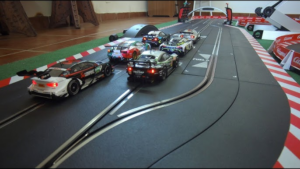
Slot car racing works by running small electrically powered car models along a track that guides the car via a plastic guide blade slotting into a groove. The power is delivered through metal rails running alongside the slot, picked up by braids on the underside of the car. The driver controls speed through a hand trigger. The car follows the track and falls off if the trigger is pressed too hard through corners, which is where all the skill resides.
Scalextric operates at 1:32 scale for its standard range, meaning cars are 32 times smaller than their real-world equivalents. Micro Scalextric and My First Scalextric use a smaller 1:64 scale designed for younger children. The two scales are not compatible with each other.
The brand’s cultural footprint in the UK is not something that can be easily replicated by a competitor. Scalextric has been part of the mainstream British toy market for seven decades, with licensing partnerships covering James Bond, Batman, the Gerry Anderson universe, Fast and Furious, Colin McRae, Gulf Racing, the British Touring Car Championship, Le Mans, and dozens of real-world motor racing manufacturers. This breadth is a genuine advantage that no competitor in the slot car space replicates at comparable scale.
What They Offer
My First Scalextric is the entry point for the youngest age group, designed for children from age three upwards. The scale is 1:64, making the track smaller and the cars correspondingly compact. Sets are available in both battery-powered and mains-powered configurations. The track layouts are simple ovals that snap together easily and can be assembled without parental engineering skill. Speed is deliberately limited to prevent frustration. Price range runs approximately £30 to £50. This is genuinely one of the few toy car products on the market that a three-year-old can meaningfully control.
Micro Scalextric sits at the same 1:64 scale as My First but targets children from age four upwards with slightly more complex track layouts and mains-powered operation. Sets introduce the competitive element more directly: two cars, two controllers, a proper race. Themed variants include Batman, law enforcement, and character-specific sets. Price range runs approximately £40 to £70.
Standard Race Sets (Analogue) are the mainstream 1:32 Scalextric product. Two 1:32 scale slot cars, two hand controllers, a transformer, and enough track to form a complete layout. This is what most people think of when they think of Scalextric. The cars are detailed scale models of real vehicles from the licensed manufacturer range: Porsche, Aston Martin, Ford, BMW, Mini, McLaren, and many others. Sets vary by theme (GT racing, touring cars, film and TV, retro) and by track layout complexity. Entry-level sets start around £90 and the mid-range sits between £100 and £150.
Hot Laps Sets are a subcategory of the standard analogue range that focus on a specific track configuration emphasising high-speed oval or sprint layouts. These are suited to buyers who want straightforward, fast racing without the complexity of multiple layout options. Film and TV licensed Hot Laps sets (Fast and Furious, Batman, WRC rally) are a significant part of this line. Price range approximately £90 to £130.
Retro Sets reproduce the visual style of 1980s Scalextric, pairing period-appropriate car liveries and designs with the current Sport track system. These appeal primarily to adults buying for themselves or sharing their own childhood experience with a new generation. The 1980s Grand Prix set is a particularly notable product in this category.
Digital Race Sets (ARC Air and ARC Pro) represent the most significant technical evolution in Scalextric’s modern history. Standard analogue slot car racing restricts each car to a single lane: the car follows the groove and cannot overtake. Digital Scalextric removes this constraint.
ARC Air adds the ARC app (available on iOS and Android, connecting via Bluetooth to the ARC powerbase) to an analogue track setup. The app provides lap counting, race timing, and race management. Controllers are wireless, removing the cable tether between the driver and the powerbase. This is analogue racing with a convenience and management upgrade. Price range approximately £170 to £200 for complete sets.
ARC Pro is the full digital system and the most capable slot car racing product Scalextric has ever made. Up to six cars can race simultaneously on the same two-lane track, with lane changing achieved through dedicated crossover track sections and a button press on the wireless controller. Race management through the ARC app introduces fuel consumption, tyre wear, variable weather conditions, KERS boost, pit stop management, post-race statistics, and eight distinct race modes including an Arcade mode with power-up pickups. Wireless controllers include a rumble pack that alerts drivers to race events like low fuel or incoming weather changes. Each car needs to be digitally enabled, either by purchasing a car that comes with a digital chip installed or by fitting a digital plug chip (sold separately at approximately £15 to £20 per car) to an existing analogue car. ARC Pro sets start around £200 and reach £350 for the most comprehensive configurations.
Individual Slot Cars are sold separately across the following categories at 1:32 scale.
Super Resistant Cars are designed with a more robust body construction to survive harder crashes and more energetic play. These are specifically the right choice for younger children or buyers who know their child is not gentle with toys. The cars use a simplified assembly that makes them more tolerant of the repeated impacts that are inevitable at the start of any slot car career. Price range approximately £25 to £35.
Film and TV Cars cover the most culturally recognised licences in the range. The Aston Martin DB5 in James Bond specification (multiple film variants available, including Goldfinger, Casino Royale, and No Time to Die), the Back to the Future DeLorean, the Batmobile across multiple Batman eras, Thunderbirds and other Gerry Anderson vehicles, the Only Fools and Horses Reliant Regal Supervan (one of the more unlikely and beloved items in the catalogue), and Fast and Furious vehicles from the 2026 25th anniversary collection. Price range approximately £30 to £55, with limited edition items reaching higher.
GT and Prototype Cars cover the endurance and GT racing category: Porsche 911 GT3, McLaren 720S GT3, Aston Martin Vantage GT3, Ford Mustang GT3, Mercedes-AMG GT3, Chevrolet Corvette C8R, Ferrari, Lamborghini, and many others. This category contains some of the most detailed and closely observed models in the Scalextric range. Price range approximately £30 to £50.
Touring Cars cover the BTCC circuit and its history, plus other national touring championships. The Volkswagen Golf Mk1 in Malcolm Jeffs Racing livery, announced in 2026, is a recent example of the brand’s eye for notable and affection-worthy liveries within this category.
Rally Cars include Colin McRae editions, Subaru Impreza WRC, Ford Puma WRC, and WRC-themed vehicles. The Colin McRae Triple Car Pack released for 2026 is a particularly significant collector item in this space.
Limited Edition Cars are produced in numbered batches. Recent examples carry print runs of 3,000 to 5,000 units and represent some of the most sought-after items in the brand’s annual output, particularly in the James Bond and Legends of Motorsport themes.
Track and Borders are the components that let buyers expand their racing layout beyond what comes in a set. Sport track is the current standard for all 1:32 Scalextric: grey plastic with orange trim, with positive-click connectors designed for secure assembly. Track comes in straights (multiple lengths), curves (standard R1 tight, R2 standard, R3 wide, R4 sweeping), and crossover pieces for digital lane changing. Track Extension Packs bundle multiple pieces together for common expansion scenarios. Track Accessory Packs include the Hot Laps Gantry (a racing arch for the track), Skid Chicane sections for the 2026 range, and pit lane sections for digital configurations. Digital track including crossover and lane changer sections is sold separately from standard Sport track and is required for ARC Pro racing.
Accessories and Spare Parts cover controllers (both wired and wireless), digital chips for converting analogue cars to digital compatibility, power supplies, scenery and buildings for layout dressing, and the Scalextric Spark Plug. The Spark Plug is a small tuning accessory that clips to the guide blade of a 1:32 car and delivers a cleaner electrical contact between the car and the track, improving both power consistency and top speed. It is a simple and inexpensive upgrade that makes a measurable difference to car performance. The spare parts section of the website is a genuinely useful resource: brushes, braids, guide blades, tyres, and other consumable components are available directly, which means maintenance rather than full replacement when a car stops performing as expected.
Merchandise covers branded clothing, accessories, and lifestyle products for Scalextric enthusiasts.
Hobby Rewards is the free loyalty programme. Points are earned on every purchase from the Scalextric website, with double and triple point promotions running regularly on selected products. Points redeem as money off future purchases. Free to join, no minimum spend to start accumulating.
Shop Scalextric Race Sets and Cars
Entry-level sets from around £50, free UK delivery on orders over £50, and a 2026 range that spans BTCC legends, Fast and Furious, James Bond, and brand new Pro digital sets. The track goes where you take it.
The Honest Review Picture
Scalextric has a complicated customer review profile that splits clearly between two distinct groups: enthusiasts who understand the product and use it correctly, and occasional or first-time buyers who expected a different experience. The gap between these groups accounts for most of the negative reviews, but not all of them.
Advantages
The car detail at the mid and upper price points is genuinely impressive. A 1:32 Scalextric GT car in 2026 carries the kind of livery accuracy, window glazing, mirror detail, and tyre compound variety that would have been considered exceptional at the top of the market twenty years ago. For adult collectors and motorsport enthusiasts who want a displayable and functional model, the quality is real.
The ARC Pro digital system is one of the most compelling home racing experiences currently available at any price. Up to six cars on the same track, lane changing that requires genuine strategy, pit stop management that rewards forward planning, weather effects that change the race in real time: this is not a toy in the traditional sense. It is a racing simulation that happens to use physical cars on a physical track. For groups of adults or families with older children, a properly configured ARC Pro layout produces a social racing experience that no video game or remote-control car can replicate. The addition of KERS, the rumble controller feedback, and the post-race statistics give it a sophistication level that the standalone track-in-a-box product does not hint at.
The ecosystem expandability is the defining commercial feature of Scalextric and the reason the brand has sustained for over seven decades. A buyer who starts with a standard set at £100 has invested in a platform to which every additional car, track piece, and accessory sold by the brand adds genuine value. A layout started in 2026 can incorporate track pieces from sets bought in 2008. New cars bought this year will run on track bought a decade ago. This backwards compatibility is a structural advantage that many competing toy categories cannot claim.
The licensing range allows almost any car interest or cultural enthusiasm to be accommodated. A buyer who wants to recreate a James Bond car chase, replicate a Le Mans podium, run a childhood hero’s livery from 1987, or simply race the car they drive to work in 1:32 scale can find something that fits. The 2026 Fast and Furious 25th anniversary release and the Colin McRae Triple Car Pack are both examples of how the brand uses licensed content to reach buyers who might not think of themselves as slot car enthusiasts first.
Spare parts availability from the official website is a genuine practical advantage over competing brands and over the typical trajectory of toy products, where replacement components are rarely accessible. The ability to replace a worn guide blade, a frayed braid, or a damaged controller cable without buying a whole new set is both economically sensible and environmentally preferable.
Super Resistant Cars address the durability problem for younger users in a direct and practical way. Buying a Super Resistant car for a child’s first independent Scalextric experience removes a significant source of the frustration that generates negative reviews about build quality.
Disadvantages
Track connectivity is the single most documented issue in Scalextric’s customer feedback across review platforms. The Sport track uses plastic press-fit connectors that, under normal use and repeated assembly and disassembly, develop contact resistance. The result is a car that runs intermittently, stalls in specific sections of track, or loses power when the track flexes. This is not a new problem: it has been present in Scalextric feedback for many years and it is the source of the most emotionally charged negative reviews, typically from parents who have bought a set for a child’s birthday and spent the birthday itself troubleshooting track connections rather than racing.
The practical solutions are real but require knowledge the product does not proactively provide: cleaning the track rails regularly with a track cleaning rubber or a dry cloth, applying braid plates at regular intervals around the circuit to improve electrical continuity, ensuring track sections are fully clicked together rather than just placed, and not assembling the track on carpet (which flexes). None of this is difficult, but it requires a user who knows to do it. First-time buyers operating on nostalgia do not typically know any of this, and the instruction materials do not make it sufficiently prominent.
The digital system setup carries a complexity cost that the packaging does not fully communicate. ARC Pro racing requires an ARC Pro powerbase, digital crossover track sections, digital chip-equipped cars, wireless controllers, and the ARC app on a compatible device. Buying a standard analogue set and then finding out that digital racing requires additional purchases of several hundred pounds combined is a source of genuine buyer frustration. The distinction between what the base set enables and what the full digital experience requires should be clearer at the point of purchase.
Individual car prices have increased steadily and the entry-level 1:32 analogue set now sits at around £90 before any expansion. For a household looking to try slot car racing casually, this is a meaningful commitment. The market for slot car starter sets has been largely captured by competitors, including Carrera at the accessible end, and Scalextric’s own pricing reflects its positioning as a premium and collector-oriented brand rather than a true mass-market entry point in 2026.
The perceived decline in build quality relative to what long-term buyers remember from the 1980s and 1990s is a recurring theme in enthusiast community feedback. Whether this reflects actual quality reduction or the distortions of nostalgia is genuinely contested, but the pattern in reviews is consistent enough to warrant flagging. Super Resistant cars represent Scalextric’s own acknowledgement that standard car durability has a ceiling at harder play levels.
Car bodies can shed detail parts during crashes, particularly rear spoilers and side mirrors. These can be clipped back on in most cases without damage, but they do detach regularly during active racing. This is not a critical fault but it is a noted characteristic that distinguishes Scalextric’s crash behaviour from some competing brands.
Who Scalextric Is Actually Good For
Adults who want a serious at-home racing hobby and are prepared to invest in an ARC Pro setup, a permanent or semi-permanent track layout, and the time to tune and maintain cars and track properly. This buyer gets the best of what the brand offers and the limitations are largely irrelevant to them.
Families with children aged eight and above who want a shared activity that rewards practice and strategy. The standard analogue race set covers this use case well. Digital adds depth as the children get older and the competitive dynamic becomes more sophisticated.
Collectors and film and TV enthusiasts who want highly detailed, licensed scale models of iconic vehicles. The James Bond, Gerry Anderson, and motorsport heritage ranges are the most significant in this category and the quality at the top of the model range is genuinely impressive.
Motorsport enthusiasts who want to race miniature versions of the cars they watch on Sundays. GT racing, Le Mans, BTCC, WRC, and Grand Prix all have dedicated and well-modelled ranges within the Scalextric catalogue.
Gift buyers for children aged five to twelve who understand that the product works best when the track is cared for, assembled on a hard surface, and maintained with occasional cleaning. If the buyer’s expectation is that the set will run indefinitely on a carpeted bedroom floor with no maintenance, that expectation needs adjusting before purchase.
Scalextric is probably not the right choice for parents looking for a truly young-child-proof outdoor toy (the track is indoor and sensitive to debris), for buyers who want a digital racing experience without setup complexity (video game racing simulators cover this more efficiently), or for households where a set will be assembled and disassembled repeatedly over a hard floor without any track maintenance.
How the Systems Actually Differ
Understanding the three core Scalextric systems before purchasing avoids most of the common buying mistakes.
Analogue (Standard): one car per lane, speed controlled by trigger pressure, two-car maximum simultaneous racing. The classic experience. No app required, no digital chips needed, no additional purchases necessary to race. This is the right system for beginners, younger children, and anyone who wants to get racing immediately without setup complexity.
ARC Air (Analogue with App): analogue racing as above, but with wireless controllers and the ARC app for lap counting, race management, and basic timing. A meaningful quality-of-life upgrade over standard analogue. Does not enable lane changing or multi-car racing. Good for buyers who want analogue simplicity with wireless controllers and race management.
ARC Pro (Digital): multiple cars on the same track simultaneously, lane changing, pit stop management, fuel and tyre simulation, weather effects, KERS, full race statistics. Requires digital crossover track sections, digital chip-equipped cars, an ARC Pro powerbase, wireless controllers with rumble feedback, and the ARC app. Significantly more expensive than analogue but delivers a fundamentally different and richer racing experience. The right choice for households with multiple drivers who want competitive racing with genuine tactical depth.
Micro Scalextric and My First Scalextric: entirely different scale from the above. Not compatible with 1:32 cars or track. Designed for younger children. Simpler, smaller, and substantially more forgiving. Not upgradeable into the standard 1:32 system.
How to Save
Join Hobby Rewards before your first purchase: the programme is free and points accumulate from the first order. Double and triple points promotions on selected products run regularly and are surfaced in the Hobby Rewards Offers section. Checking this section before purchasing individual cars or track pieces can meaningfully reduce the effective cost of expanding a layout.
Buy sets in the Black Friday and Christmas sale window: Scalextric runs promotional pricing during major retail periods. Standard race sets and digital sets have historically carried 15 to 25 percent discounts during these windows on the official website and at major UK toy retailers including Smyths, Argos, and Amazon.
Check the Last Chance to Buy section: the website maintains a clearance section with discounted pricing on outgoing stock. Previous-year car models and discontinued track accessories appear here at reduced prices and remain fully compatible with current Sport track.
Buy individual cars rather than replacing sets for expansion: a second car for an existing set costs approximately £25 to £35. Buying a second complete set to add cars is unnecessary and significantly more expensive. The track from the first set is sufficient to start; more track can be added separately.
Use the spare parts section for maintenance rather than replacement: when a car stops running well, the component that has failed is almost always a consumable: the guide blade, the pick-up braids, or the tyres. These parts are available individually from the Scalextric website for a few pounds and restoring a car through part replacement is substantially cheaper than buying a replacement car.
Add the Scalextric Spark Plug before buying a new car: if a car is running inconsistently, the Spark Plug accessory is worth trying before attributing the issue to a faulty car. It clips directly onto the guide blade and improves the electrical contact between the car and the track, which resolves most low-speed running issues for approximately £5 to £8.
Clean the track rails regularly: this is the single most cost-effective performance improvement available and it is free. A dry cloth or a dedicated track cleaning rubber wiped along both metal rails before a race session removes the oxidisation and rubber deposit build-up that causes most track power delivery problems.
Shop by manufacturer for specific car interests: the manufacturer filter on the Scalextric website (covering Aston Martin, BMW, Ford, McLaren, Mini, Porsche, and others) surfaces all available cars in a specific make, which is useful for buyers who want to race a particular manufacturer’s cars across multiple models or eras.
Build Your Circuit for Less with Hobby Rewards and the Sale Section
The Scalextric Hobby Rewards programme is free to join and starts with 200 bonus points at signup. Every pound you spend earns more points, which unlock exclusive member-only offers, early access to new range launches, and competition entries. The sale and clearance sections regularly carry discounts of up to 40% off selected cars and up to 30% off track extension packs, which is the most cost-effective way to expand a circuit beyond the starter layout. Bundle deals group sets, cars, and accessories at a better combined price than buying individually. For younger racers, My First Scalextric sets are designed for ages three and up and offer a lower-cost entry point with simplified controls. Signing up to the newsletter is worth doing before your first purchase, as it carries promotional codes and advance notice of timed offers tied to major motorsport events throughout the year.
Frequently Asked Questions
What age is Scalextric suitable for?
My First Scalextric targets children from age three upwards. Micro Scalextric is recommended from age four. Standard 1:32 analogue Scalextric is recommended from age five. ARC Pro digital sets are recommended from age eight due to the additional complexity of lane changing, app management, and multi-car strategy. The age recommendations reflect both the physical size of the track and the cognitive demands of each system. Adult collectors and hobbyists are a significant part of the active Scalextric buyer base.
Why do the cars keep stopping on my track?
The most common cause is poor electrical contact between the track’s metal rails and the underside of the car’s pick-up braids, or poor contact between track sections at the connectors. Practical fixes include: ensuring all track sections are fully pressed together until the connector clicks; cleaning the metal rails along the entire circuit with a dry cloth or track cleaning rubber before each session; replacing worn braids on the underside of the car (these are inexpensive spare parts available from the Scalextric website); and assembling the track on a hard, flat surface rather than carpet, which allows the track to flex and break electrical continuity. The Scalextric Spark Plug accessory also helps by improving the contact between the guide blade and the slot.
Can I mix old and new Scalextric track?
Current Sport track (the standard from approximately 2000 onwards) is compatible with most current and recent 1:32 cars. Classic track from the pre-2000 era can be connected to Sport track using the C8222 adaptor pieces. Start track (a now-discontinued variant) connects to Sport track via C8525 adaptors. Micro Scalextric and My First Scalextric use 1:64 scale track and are not compatible with 1:32 Sport track. Digital crossover sections are Sport track format and compatible with any Sport track layout.
What is the difference between analogue and digital Scalextric?
Analogue Scalextric gives each car its own dedicated lane. The car stays in that lane for the entire race and cannot overtake except at the point where drivers swap lanes by mutual agreement. Digital Scalextric adds crossover track sections and digital chips to cars, allowing drivers to actively change lanes during a race by pressing a button on the controller. The ARC Pro system extends this to up to six cars simultaneously, with fuel management, weather, tyre wear, and pit stop strategy layered on top. Digital cars can also run on analogue tracks without any lane changing functionality.
Do I need an app to run a Scalextric set?
Standard analogue sets require no app. The track, transformer, and controllers are the complete system. ARC Air and ARC Pro sets use the free ARC app (iOS and Android) connected via Bluetooth to the ARC powerbase for race management features. The ARC Pro system uses the app for race setup, mode selection, and statistics. A compatible smartphone or tablet is required for these sets but is not included in the box.
Are limited edition Scalextric cars worth buying?
From a collecting perspective, Scalextric limited editions have a track record of holding value within the hobby community, particularly James Bond, Gerry Anderson, and motorsport heritage models. Print runs of 3,000 to 5,000 units on announced limited editions create genuine scarcity over time. From a running perspective, limited edition cars perform identically to standard cars of the same type. Buyers purchasing specifically to run rather than collect should not feel compelled to seek limited editions: the standard range delivers the same on-track performance.