Affiliate Disclosure: This post may contain affiliate links. If you click and make a purchase, we may earn a small commission at no extra cost to you. Read more at our Affiliate Disclosure page.
Every parent eventually faces the same negotiation. The child wants a phone. The parent wants to stay connected without handing over a device that opens a browser, an app store, and unfettered access to every corner of the internet in one move. The compromise most families land on is a kids smartwatch, and the first brand that tends to come up in that research is myFirst.
Whether myFirst is the right answer depends on which child you are buying for, which product you choose within a range that is considerably broader than most people realise, and whether you understand the ecosystem logic that runs underneath everything the brand makes. Getting those three things right is the difference between a gift that a child actually wears every day and a device that sits in a drawer after a month.
This review covers the complete myFirst product range, the honest limitations across several of its most popular products, and who the ecosystem genuinely serves best.
What myFirst Actually Is
myFirst is a Singapore-based consumer technology company founded in 2017, positioning itself as the world’s first connected kids tech ecosystem. The brand describes its mission as empowering children with creativity, connection, and independence while building healthy digital habits and strengthening family bonds. It operates regional storefronts across Singapore, the US, UK, Europe, Australia, Japan, South Korea, Thailand, Vietnam, and Hong Kong.
The brand has been covered by Forbes, The New York Times, NBC, Wired, USA Today, TODAY, and several specialist parenting and tech publications. It showcased its full ecosystem at CES 2026, where the Frame Clario, Insta Lux camera, CareBuds Max, and Fone S4 smartwatch were presented together as a working connected family system. Over one million families worldwide have purchased myFirst products.
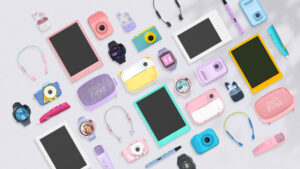
The unifying thread across every product myFirst makes is myFirst Circle, a proprietary family platform that acts as the operating environment connecting smartwatches, cameras, digital frames, and audio products under one parent-controlled ecosystem. Understanding Circle is the starting point for understanding why myFirst’s approach is genuinely different from simply buying a kids smartwatch and a separate camera and a separate pair of headphones.
What They Offer
Fone S4 is myFirst’s current flagship smartwatch, designed for children aged 5 to 12. The hardware centres on a 1.65-inch AMOLED display, 4G LTE connectivity via eSIM, a 5MP HDR camera, real-time GPS tracking, geo-fencing with safe zone alerts, voice and video calling, group chat, Class Mode for school hours, an SOS button that triggers a location alert and 30-second ambient audio recording to the parent’s app, a step counter, heart rate monitor, music player, and the Magic Button, which is customisable for single click, double click, and press-and-hold functions. A new feature called MagiCode allows parents to send preset silent vibration sequences to a child’s wrist, a concept designed for discreet communication without noise or screen interaction.
The S4 connects to the myFirst Circle app on the parent’s phone for managing contacts, setting class mode schedules, monitoring location, and reviewing the gamification features introduced in Circle 3.0, where children earn badges and a carrot-based currency for steps, activity, chores, and habits set by parents. The S4 is eSIM-only and requires a myFirst FreeSIM plan for 4G features. Battery life in real-world testing runs approximately one day under normal use.
Fone R2 is the round-form-factor alternative to the S4’s square design, currently positioned as the most popular watch in the myFirst range by independent review coverage. The R2 shares most of the S4’s core functionality: 4G via eSIM, 5MP camera, GPS with geo-fencing, voice and video calls, Class Mode, SOS with 30-second audio recording, music player, and Magic Button customisation. It adds a distinctive feature called Shake-to-make-friends, which pairs two Fone R2 devices automatically when children physically shake them near each other, enabling direct calls and emoji messaging between paired watches. The R2 has a 1.3-inch AMOLED screen and IPX8 water resistance, making it fully waterproof rather than splash-resistant. Battery life runs up to two days with moderate use. Available in Cotton Candy Mix, Macaron Pink, Mixed Berries, Nougat White, and Açai Purple.
Fone S3+ is a mid-range option with built-in eSIM, 2MP camera, GPS, voice and video calling, messaging, and fitness tracking. Suited to buyers who want core safety and connectivity features at a lower entry price than the R2 or S4.
Fone R1s provides the essential communication and GPS package in a round form factor for buyers focused on the fundamentals: voice calls, GPS, location history, and parent-managed contacts.
myFirst FreeSIM is the eSIM plan that powers 4G connectivity on the Fone S4, R2, and S3+. In the US, it uses Smart Carrier Selection, automatically switching between AT&T, T-Mobile, and Verizon to connect to the strongest available network. Free roaming within North America is included. A one-month free trial ships with new devices. Monthly and annual plans are available, with annual billing offering the lowest per-month cost. In Singapore, plans run from approximately S$6.99 per month on annual billing.
Stay Connected Free Device Programme is available in Singapore and expanding to Malaysia and the US, allowing families to obtain a myFirst device at no hardware cost with a qualifying FreeSIM plan subscription.
CareBuds Max are over-ear headphones designed specifically for children with a dual-mode volume limit: 85dB Safe Mode for everyday school and home use, and 94dB Travel Mode for noisier environments like flights and public transport. The volume limit is hardware-based rather than software-based, which means it cannot be easily bypassed. Smart Transparency mode lets children hear their surrounding environment without removing the headphones. Battery life reaches 52 hours. USB-C wired mode works when the battery runs out. An ENC microphone handles call and voice note recording. A dual listening feature allows two children to connect to a single device simultaneously by pairing a second set of earbuds or headphones, useful for shared watching or listening on trips. Seasonal ear pad sets include breathable summer pads and fleece-lined winter pads. Available in Blueberry Pop, Mist White, and Cotton Candy Mix. The CareBuds Max was showcased at CES 2026.
CareBuds 2 (CareBuds) are in-ear earbuds with a hardware volume limit, available in multiple colours including Blue, designed for children who prefer the in-ear form factor. Positioned below CareBuds Max in the audio hierarchy.
Voice 2 is a portable Bluetooth speaker in the audio line.
Insta Lux is the most capable instant print camera myFirst makes. A 12MP Sony sensor powers a 2.8-inch display body with dual lenses and an extra shutter button positioned to allow selfie-style capturing without repositioning the camera. Printing uses dye sublimation rather than inkless thermal technology, which means prints are waterproof, fingerprint-proof, and rated to last over 100 years without colour fading. Each print costs under 90 cents SGD. The camera connects to myFirst Circle via Wi-Fi, allowing photos taken on other devices (a parent’s phone, a sibling’s tablet) to be sent to the Insta Lux for printing. Photo editing, filters, and creative frames are available within the camera interface. Launched at CES 2026, the Insta Lux also accepts prints wirelessly from any myFirst Circle-connected device. Available in Grey and Cotton Candy Mix.
Insta Wi and Insta 20 are earlier instant print camera models with more modest specifications, suited to younger children or lower-budget purchases.
Camera 50 and Camera 10 are digital cameras without print functionality, suited to children who want to capture photos and videos without the print element.
Camera 3 is the most accessible entry-level digital camera in the range.
3dPen Artist is the advanced 3D printing pen, suited to older children with some experience in 3D creative work.
3dPen Make is the child-focused 3D printing pen with safety as a design priority: the printing material is kid-safe, the tip cools to a safe temperature almost instantly after printing stops, and the body is lightweight enough for young hands. Suitable from approximately age six upward.
Sketch Pro Neo is a digital drawing tablet with a stylus for children interested in digital illustration, animation, and design.
Sketch Book is an analogue creative product in the myFirst drawing line.
Frame Clario is myFirst’s 7-inch digital family frame and the centrepiece of the CES 2026 ecosystem announcement. It connects to myFirst Circle and functions as a family communication hub: receiving and displaying photos shared by family members, enabling live video calls directly through the frame, playing voice notes, and showing Momoji reactions. A built-in Magic Button lets users start a slideshow, place a call, or send a message in one press. The Mino Dock attaches to the top of the Frame Clario and lets Fone S or R series smartwatches charge directly from the frame without requiring a separate cable. Soundscape is a built-in audio feature offering white noise, lullabies, and ambient sounds for study and sleep, with a Mix function that lets children combine sounds (rain, ocean, birds, streams) into personal soundscapes. The Frame Clario also displays calendar items, reminders, to-do lists, and real-time weather. The Circle 4.0 update introduces Circle Map 2.0 for live group location viewing and Ghost Mode, which allows parents to check a child’s location without generating a notification on the child’s watch.
Frame Doodle is a digital drawing frame combining display and creative functionality.
Frame Live is a digital photo frame with live-update capability.
myFirst Circle is the family platform that connects every product in the range. It is a private, parent-managed environment: parents control who children communicate with, which contacts appear on the watch, what the class mode schedule looks like, and what content is displayed on connected frames. Children within the same Circle can share photos, send voice notes, earn activity badges, and interact through Momoji emoji reactions. Circle is not a public social network. It functions as a closed family-and-trusted-friends environment that the child cannot extend beyond the parent’s approval. Circle 4.0, due progressively across 2026, adds Ghost Mode location checking and the upgraded Circle Map 2.0 for group live tracking.
Shop myFirst Kids Tech
GPS tracking, video calls, SOS alerts, and parental controls on the wrist. The myFirst Fone R2 and Fone S4 give kids the connection they need without handing them a smartphone they are not ready for.
The Honest Review Picture
myFirst has earned its position as the most frequently recommended brand in the kids connected device space across publications including SafeWise, Android Central, Mother and Baby, and ParentMap. The Fone R2 in particular receives strong independent testing marks for the combination of video calling, GPS accuracy, water resistance, and the Shake-to-make-friends feature that competing brands have not replicated.
The brand’s CES 2026 presence and the Frame Clario announcement confirm a coherent ecosystem strategy that is advancing rather than stalling. The honest complications are real but specific, and they cluster around software maturity rather than hardware quality.
Advantages
The myFirst Circle ecosystem genuinely solves the problem it was designed for. A child using a Fone R2 communicates only with approved contacts, shares photos only within the family circle, and interacts with content that parents have explicitly allowed. This is meaningfully different from a stripped-down smartphone, which still runs an operating system that can be circumvented, app stores that require active management, and browsers that require filtering. The Circle environment is closed by architecture rather than by policy, which matters for parents who know that curious children will find the edge of any policy-only restriction.
The Fone R2’s IPX8 water resistance is the highest waterproof rating in the kids smartwatch category and significantly outperforms the splash resistance of competing models. For children who swim, play in rain, or are reliably careless with electronics, this matters practically. Parents in documented reviews report the watch surviving rain, hand washing, and submersion without any operational impact.
The SOS feature with 30-second ambient audio recording is a genuine differentiator. Most kids smartwatches send a location alert when the SOS button is pressed. The Fone R2 and S4 also record 30 seconds of surrounding audio and deliver that recording to the parent’s Circle app, which gives context to the alert rather than leaving a parent responding to a location without knowing whether the situation is dangerous or accidental. One press, location plus audio, immediate notification.
The hardware volume limiting on CareBuds and CareBuds Max is implemented at the hardware level rather than through software controls that an older child can navigate around. The World Health Organization recommends limiting children’s audio exposure to 85dB for extended periods. The hardware-based implementation on CareBuds Max enforces this at 85dB in Safe Mode regardless of what device volume the headphones are connected to, which represents meaningful protection compared to software volume caps that can be overridden.
The Insta Lux’s dye sublimation printing represents a genuine step up from the thermal paper approach used in most kids instant cameras. Thermal prints fade, cannot get wet, and are sensitive to heat and light. Dye sublimation prints from the Insta Lux are waterproof, fingerprint-resistant, and rated to last over 100 years, which means a child’s favourite photos hold up rather than yellowing in a shoebox. At under 90 cents SGD per print, the ongoing cost is accessible for regular creative use.
The brand’s coverage in Forbes, NYT, NBC, and Wired, and its active presence at CES 2026, provide the kind of third-party editorial validation that confirms this is a serious technology company rather than a white-label gadget operation.
Disadvantages
Battery life on the Fone S4 is the most significant documented issue and one that independent testing confirms rather than contradicts. The device lasted less than a day in normal use in the most detailed available review, dropping to 33% battery after a single idle day, and finishing an active day with less than 20% remaining. For a device marketed to parents as a school-day safety tool, a battery that requires daily charging and may not reliably survive from morning drop-off to afternoon pickup is a real operational concern. The Fone R2’s battery is rated up to two days and performs meaningfully better in this regard.
The FoneOS software on the Fone S4 has been described in published reviews as the product’s weak link, with the gamification features feeling perfunctory and the habit trainer function buried in the app interface in a way that required a helpdesk query to locate. The MagiCode vibration messaging feature, which is a notable headline addition on the S4, has been specifically criticised for its implementation: the watch’s haptics cannot replicate distinct vibration patterns clearly enough for the code to be decipherable, which undermines the feature’s core premise. myFirst has a track record of improving software through updates, and these issues reflect the S4’s relatively recent launch, but buyers purchasing at launch should be aware they may be buying into an evolving software experience.
The eSIM-only architecture on the S4 and R2 means that 4G connectivity is tied to a FreeSIM plan rather than any SIM card. This creates a recurring monthly or annual cost that is ongoing for as long as the child uses the watch for 4G features. The cost is not large (under $10 per month on monthly plans, less on annual), and the Smart Carrier Selection offering simultaneous access to AT&T, T-Mobile, and Verizon in the US is a genuine connectivity advantage. But the dependency on myFirst’s own service means that if the FreeSIM plan is discontinued or pricing changes, the connectivity proposition changes with it. Buyers should factor ongoing plan costs into the total purchase consideration.
The coolness trajectory of a kids smartwatch has a natural ceiling for older children. Multiple independent parenting sources and myFirst’s own blog acknowledge that children around 11 and 12 increasingly push back against a smartwatch as their peer group transitions to smartphones. The device serves the 5 to 10 window most reliably. Families buying for a child who is already on that boundary may find the lifespan of the device shorter than expected.
One parent review documented a call function error on the Fone R2 in the US that prevented calls from being initiated through the app despite all other features working correctly. This kind of connectivity issue, when it appears, requires working through support rather than a self-service fix, and the timeline for resolution is not guaranteed.
Who myFirst Is Actually Good For
Parents of children aged 5 to 10 who want to stay connected with their child without giving them a smartphone. This is myFirst’s strongest and most clearly defined buyer. The combination of GPS, approved-contacts-only calling and video, Class Mode, and SOS creates a safety infrastructure that a smartphone cannot match without significant additional configuration and ongoing monitoring.
Parents of children with autism or other neurodivergent conditions who benefit from the GPS tracking without the social complexity and unpredictability of open internet access. Multiple documented parent reviews specifically describe the myFirst watch as well-suited to this use case because of the simplified interface, reliable GPS, and the ability to limit contact to trusted people only.
Families who want grandparents and extended family to stay connected with a child in a safe and simple way. The Frame Clario addresses this specifically: a grandparent with the Frame Clario in their home receives shared photos, can make video calls, and sends voice notes through an interface that requires no technical sophistication, while the child’s Circle manages what content goes where.
Creative children who want a camera that makes something physical. The Insta Lux addresses a specific desire that phone cameras do not: the immediate, tactile reward of a printed photograph. Children who collect things, journal, or decorate physical spaces respond to instant print cameras in ways that digital-only cameras do not capture.
Gift buyers looking for a distinctive, well-validated tech gift for children in the 5 to 12 age range. The myFirst Fone R2 in particular has the editorial validation from SafeWise, Android Central, and multiple parenting publications that makes it a gift with credible independent backing. The 3dPen Make and Insta Lux are strong gift options for creative children who do not need a connected device.
myFirst is probably not the right fit for children over 12 who are starting to want the social features of a proper smartphone, for parents who want to avoid an ongoing SIM subscription cost, or for buyers specifically looking for a smartwatch with advanced sleep tracking or fitness metrics, where dedicated wearable brands outperform.
How the Fone Models Actually Differ
Fone R2 versus Fone S4: the R refers to the round design and the S to the square design. These are not simply cosmetic variants. The R2 has IPX8 waterproofing, Shake-to-make-friends, and a two-day battery. The S4 has a larger 1.65-inch AMOLED screen, the MagiCode vibration messaging feature, and Circle 3.0 gamification with the carrot reward system. The S4’s hardware is roughly equivalent to the R2 but its software is newer and in active development, which introduces more features but also more rough edges. For most families buying now, the R2 is the more reliable choice because its software is mature and its battery life is better. The S4 suits buyers who specifically want the larger screen or the gamification system and are comfortable with software that may continue to evolve.
Fone R2 versus Fone S3+: the R2 is the premium round model with the full feature set including IPX8 water resistance, 5MP camera, and Shake-to-make-friends. The S3+ is a mid-range entry point with a 2MP camera and the core GPS, calling, and messaging features. For first-time buyers who are uncertain whether a child will actually wear a smartwatch daily, the S3+ represents a lower-risk entry cost before committing to the R2.
Fone R1s: the baseline GPS and calling model. The right choice for parents who want the fundamental safety and communication features only, without paying for camera quality or advanced features the child is too young to use independently.
How the Camera Models Actually Differ
Insta Lux versus earlier instant cameras (Insta Wi, Insta 20): the Insta Lux uses dye sublimation printing, which produces waterproof and long-lasting prints. Earlier models use thermal printing, which produces prints that can fade and are sensitive to light and heat. The 12MP Sony sensor and 2.8-inch display on the Insta Lux also represent a significant image quality step up. If the quality and longevity of prints matters, the Insta Lux is the clear choice. If budget is the priority and print permanence is not a concern, the Insta 20 covers the basic instant print experience at a lower price.
Camera 50, Camera 10, Camera 3 versus Insta cameras: the numbered cameras are digital-only and do not print. They suit children who want to photograph and video their world for digital sharing through Circle, without the print element. The Insta cameras suit children for whom the physical print is the specific appeal.
How to Save
Buy from the regional myFirst store directly: myFirst operates dedicated storefronts for the US, UK, Europe, Australia, Singapore, and other markets. Buying from the relevant regional store ensures correct device configuration for local networks and correct FreeSIM compatibility. Prices may also vary between the global store and regional stores.
Choose annual FreeSIM billing over monthly: monthly plans cost more per month than annual billing. If a child is reliably going to wear the watch through the school year, the annual plan provides meaningful savings on what is an ongoing recurring cost.
Use the one-month free trial before committing to a plan: every new Fone device ships with a one-month FreeSIM trial. Using the trial to verify that the Smart Carrier Selection works reliably in your specific location before committing to an annual plan is sensible.
Check the Stay Connected Free Device Programme: in Singapore, this programme provides a device at no hardware cost with a qualifying plan subscription. Expanding to Malaysia and the US, this represents a meaningfully different financial structure for families confident they will use the FreeSIM service for an extended period.
Buy the Insta Lux for a child who creates consistently: the print cost of under 90 cents SGD per print rewards frequent use. Buying the camera for a child who will print daily or weekly is a better value calculation than buying it for a child who may use it on special occasions only.
Bundle within the Circle ecosystem: buying a Fone and a Frame Clario together creates the most connected family experience but also unlocks the Mino Dock integration that makes the frame useful as a charging station for the watch. If both products are on the purchase list, buying together rather than sequentially is more practical.
Sign up for myFirst communications before purchasing: myFirst periodically runs promotional events and launch discounts. Newsletter and social channel subscribers receive early access to these.
Give Them Independence Without Giving Them the Internet
The myFirst ecosystem covers ages 5 to 12 with smartwatches, volume-limited headphones, instant print cameras, and a private family platform called myFirst Circle that ties everything together. The Fone S4 is the current flagship, with 4G LTE, real-time GPS, geofencing alerts, video calls to approved contacts only, and a Class Mode that silences everything except the SOS button during school hours. The Fone R2 is the more accessible entry point, with the same core safety features at a lower price. Neither watch exposes kids to social media, advertising, or contacts outside the whitelist parents set up. The myFirst Circle app lets parents track location, manage contacts, and adjust permissions from their phone. A monthly service plan is required for cellular features, but the watch connects via Wi-Fi at home without one. For families weighing whether to delay the first smartphone, this is the most complete alternative currently available in the market.
Frequently Asked Questions
What age range is myFirst designed for?
The recommended age range for the Fone smartwatch series is 5 to 12 years old. The camera, audio, and drawing products do not have strict age limits but are designed with primary school-age children as the primary user. Products like the 3dPen Make recommend parental supervision for younger children. The Frame Clario is as much a product for grandparents and family members as for the child, functioning as a family hub that adults in the ecosystem receive content through.
Does the watch need a SIM card to work?
Basic features including timekeeping, the camera, music player, step counting, and locally stored content work without a SIM plan. The 4G features that make the watch a communication and GPS device, including calls, video calls, messages, GPS tracking, and SOS, require an active FreeSIM plan. The S4 and R2 use eSIM, meaning there is no physical SIM tray. A one-month trial is included with new devices.
How does myFirst Circle work?
myFirst Circle is a private family platform managed by parents through a smartphone app. Parents create a Circle, add the child’s device, and control which contacts the child can communicate with. Children cannot add their own contacts or receive messages from outside the approved list. The Circle connects Fone smartwatches, cameras, and Frame Clario devices so that photos and messages shared within the family stay within that closed environment. It is not connected to any public social network.
Is the battery life adequate for a school day?
The Fone R2 typically lasts two days on moderate use and survives a full school day comfortably with battery to spare. The Fone S4’s battery is shorter in practice and the safest approach is nightly charging to guarantee a full day of operation. For the R2, every-other-night charging is typically sufficient for families with children who use the watch moderately. Families with children who make frequent video calls or use continuous GPS throughout the day should expect to charge nightly regardless of model.
Is the volume limit on CareBuds Max enforced in hardware?
Yes. The 85dB Safe Mode limit is hardware-based rather than software-based, meaning it cannot be bypassed by adjusting volume settings on the connected device. The 94dB Travel Mode option is also hardware-limited. This is the meaningful distinction between the CareBuds Max and generic children’s headphones that implement volume limits through software controls, which a determined child can bypass by connecting to a different device or adjusting settings.
What happens when the child outgrows the watch?
Most children transition away from a kids smartwatch between ages 11 and 13 as peer groups shift to smartphones. The myFirst Circle platform remains accessible through the parent’s smartphone, and cameras, audio products, and Frame Clario continue to be relevant beyond the watch transition. For families who want to extend the connected experience as children get older, myFirst’s ecosystem is worth assessing as a whole rather than as a single-device purchase, since several products in the range remain relevant at ages where the smartwatch itself starts to feel limiting.