
Affiliate Disclosure: This post may contain affiliate links. If you click and make a purchase, we may earn a small commission at no extra cost to you. Read more at our Affiliate Disclosure page.
If you have spent any time on YouTube in the last five years, you have probably been offered a NordVPN discount code by at least a dozen creators. The ads are everywhere: tech channels, gaming channels, cooking channels, true-crime podcasts. The brand has become so synonymous with VPN advertising that it is easy to mistake name recognition for quality, and just as easy to dismiss it as hype.
Neither reaction is quite right. NordVPN is a genuinely strong VPN service that earns most of its top-tier rankings on technical merit. It is also a company whose billing practices have attracted multiple class-action lawsuits and whose introductory pricing model is designed in a way that catches a significant number of subscribers off guard at renewal. Understanding both sides of that picture is what this review is for.
What NordVPN Actually Is
NordVPN is a virtual private network service operated by Nord Security, a cybersecurity company formally headquartered in Panama and founded by Lithuanian entrepreneurs. The service has been running since 2012 and has grown to become the most widely recognised consumer VPN in the world by brand awareness, largely through an aggressive influencer and affiliate marketing strategy that predates most of its competitors in that space.
A VPN works by routing your internet traffic through an encrypted tunnel to a server in a location of your choice. This masks your real IP address from websites, your internet service provider, and anyone monitoring the network you’re using. Practical use cases include securing your connection on public Wi-Fi, accessing streaming content from different regions, bypassing censorship in countries with restrictive internet policies, reducing tracking by advertisers, and adding a general layer of privacy to everyday browsing.
Nord Security also owns Surfshark, another widely used consumer VPN, following a merger in 2022. The two services continue to operate as separate products with separate apps, pricing, and server networks, but they share ownership and some infrastructure investment. This is worth knowing if you are cross-shopping between them.
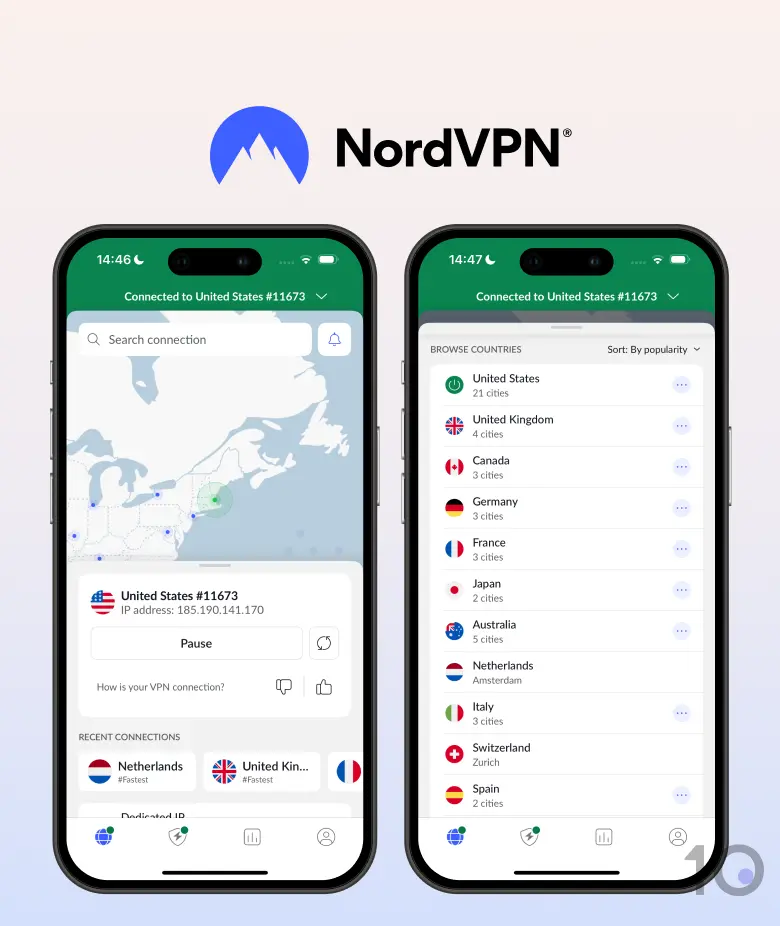
NordVPN’s core technical credentials are strong. The service runs more than 8,000 servers across 118 countries, all on RAM-only hardware, which means no data can be stored on disk and every server reboot wipes all information clean. Its no-logs policy has been independently audited six times, most recently by Deloitte at the end of 2024. The service is based in Panama, which sits outside the Five Eyes, Nine Eyes, and Fourteen Eyes intelligence-sharing alliances, meaning it is not subject to the data-retention laws that affect VPN providers in the US, UK, Europe, or Australia.
Try NordVPN Risk-Free for 30 Days
Over 7,200 servers across 111 countries, AES-256 encryption, a verified no-logs policy, and a 30-day money-back guarantee. Full access from day one, no restrictions.
What They Offer
Basic Plan is the entry-level tier. Starting at approximately $3.09 to $3.39 per month on a two-year subscription, it gives you the full core VPN service: 8,000-plus servers, connection for up to 10 devices simultaneously, AES-256 encryption, the NordLynx protocol (NordVPN’s WireGuard-based custom protocol, the fastest option available), kill switch, split tunneling, Double VPN, Onion over VPN, obfuscated servers for restricted network environments, SmartPlay for streaming, and Meshnet for device networking. Threat Protection at the Basic tier is a lighter version that blocks known malicious URLs but does not include full file scanning or advanced tracker blocking.
Plus Plan adds Threat Protection Pro, the more comprehensive version that blocks intrusive ads, web trackers, and malware at the DNS level and scans downloaded files for threats before they execute on your device. It also includes NordPass, Nord Security’s password manager with a built-in data breach scanner. On a two-year plan, the Plus tier costs approximately $3.59 to $3.89 per month at current promotional rates, making the upgrade roughly $1 more per month than Basic.
Complete Plan builds on Plus with 1TB of encrypted cloud storage through NordLocker, Nord Security’s end-to-end encrypted file storage product. Useful for users who want to consolidate their privacy and storage tools under one subscription. Two-year pricing runs around $4.89 to $5.49 per month.
Prime Plan (available in the US only) adds NordProtect, the company’s identity theft protection bundle. This includes 3-Bureau credit monitoring, TransUnion credit lock, short-term loan monitoring, financial account monitoring, dark web monitoring, and up to $1 million in identity theft recovery insurance. The Prime plan was expanded in December 2025 with additional financial monitoring features. Two-year pricing sits around $6.99 to $8.09 per month. For users who have recently experienced identity theft or who manage significant financial accounts, the insurance and monitoring features carry real value. For the average user, the Complete plan is likely sufficient.
Monthly Plans are available across all tiers but priced significantly higher: the Basic monthly plan runs $12.99 per month, which over two years costs more than five times the equivalent two-year plan. The monthly option is practical for short-term needs like international travel, but as a long-term arrangement it represents substantially worse value.
NordLynx Protocol is NordVPN’s proprietary implementation built on WireGuard. In independent speed testing across multiple markets, NordLynx consistently delivers average speeds retaining 80 to 95 percent of the user’s base connection speed, making it among the fastest protocols available from any consumer VPN. UK morning speeds have been recorded at 780 Mbps and evening speeds exceeding 950 Mbps in independent tests.
NordWhisper is the newest protocol, introduced in late 2025. It wraps VPN traffic inside standard HTTPS using technology derived from the Tor Project’s WebTunnel, making it appear indistinguishable from regular web browsing. This is specifically designed for environments that actively detect and block VPN traffic, including restrictive corporate networks, school networks, and countries like China or Russia where VPN use is heavily restricted. Note that NordWhisper is not compatible with Threat Protection Pro’s ad blocker functionality.
Threat Protection Pro works independently of the VPN tunnel, meaning it continues blocking ads, trackers, and malicious downloads even when the VPN is disconnected. It received recognition from AV-Comparatives in 2024 as an effective anti-phishing tool, a distinction typically reserved for dedicated antivirus software.
Meshnet allows users to create a secure virtual network between their own devices, or between their devices and those of trusted contacts. This enables direct encrypted connections between machines for file sharing, remote access, or routing traffic through a home network from abroad, without going through NordVPN’s servers at all. Meshnet is available as a free feature, including to non-subscribers.
Double VPN routes traffic through two different VPN servers and two layers of encryption. This reduces speed but adds a second layer of privacy, making it significantly harder to correlate entry and exit traffic. Suited for journalists, activists, or anyone in high-risk privacy situations.
Dedicated IP is an optional paid add-on that assigns a fixed IP address to your account rather than sharing a rotating pool with other users. Useful for accessing services that block known shared VPN IP ranges, for maintaining consistent access to IP-whitelisted systems, or for reducing CAPTCHA interruptions. Additional cost on top of the base subscription.
SmartDNS allows streaming devices that do not natively support VPN apps (certain smart TVs, gaming consoles, streaming sticks) to unblock geo-restricted content through DNS-level routing. Available across all plans.
30-Day Money-Back Guarantee applies to all plans and is handled through customer support, not an automated portal. The guarantee is genuine: refund requests within 30 days are processed, generally within five to ten business days.
The Honest Review Picture
NordVPN holds the top or second position in virtually every major independent VPN ranking in 2026, and the technical reasons for that are real. Speed, server coverage, security architecture, streaming unblocking, and no-logs credibility are all genuinely best-in-class or close to it. The platform has earned its reputation on substance, not just marketing spend.
The complications are concentrated in two specific areas: the pricing structure at renewal, and a history of security incidents and legal challenges that are worth understanding rather than dismissing.
Advantages
The NordLynx protocol is one of the most material differentiators NordVPN offers. Speed loss on a VPN connection is the most common practical complaint from users, and NordLynx’s WireGuard-based architecture reduces that loss more than most competing protocols. Independent speed tests in 2025 and 2026 consistently show NordVPN outperforming Surfshark, ProtonVPN, and coming close to ExpressVPN on most routes. On a 100Mbps connection, users typically retain 85 to 95Mbps through NordLynx, which is genuinely enough for 4K streaming, video calls, and most data-intensive tasks.
Streaming performance is excellent across the major services. Netflix, BBC iPlayer, Disney+, ITVX, Channel 4, and most regional streaming libraries unblock consistently. SmartPlay handles streaming-specific routing automatically without manual server switching. One notable exception is Amazon Prime Video, which has been a persistent weak point for NordVPN and does not unblock reliably.
The security architecture is among the most credible in the industry. RAM-only servers, independently audited no-logs policy (six times, by PwC and Deloitte), Panama jurisdiction, post-quantum encryption on NordLynx (using ML-KEM, a quantum-resistant standard), and a public bug bounty programme all represent genuine security investment rather than marketing posture. The addition of post-quantum encryption in 2025 specifically addresses the “harvest now, decrypt later” threat, where adversaries capture encrypted data today to decrypt it once quantum computing matures. Not every competitor has implemented this.
Threat Protection Pro represents real added value for the Plus plan price. Unlike browser-extension ad blockers that only work in the browser, Threat Protection Pro operates at the DNS level across all traffic on the device, blocking ads, trackers, and malicious content in apps and browsers simultaneously. AV-Comparatives’ recognition of it as an effective anti-phishing tool, a distinction usually given to antivirus software, is a meaningful independent validation.
Customer support quality is above average for the VPN industry. Live chat connects to a human agent in under 30 seconds once you move past the initial chatbot step. Support is available 24/7, handles questions from non-subscribers, and consistently receives positive reviews on technical knowledge in independent assessments. This is a genuine differentiator from providers that rely entirely on automated support.
Disadvantages
The renewal pricing structure is the single most documented source of user dissatisfaction and the subject of multiple ongoing class-action lawsuits. NordVPN’s introductory pricing on two-year plans runs from approximately $3.09 to $8.09 per month depending on tier. When that two-year term ends and the subscription auto-renews, the price resets to the current standard monthly rate, which is approximately $12.99 to $16.99 per month depending on tier. That is a potential jump from $74 per year to $156 per year or more, depending on what plan you originally chose.
Multiple class-action lawsuits filed between 2024 and 2026 allege that Nord Security uses “dark pattern” website design and inadequate disclosure of renewal terms to trap consumers into unexpected charges. NordVPN disputes these characterisations and states that renewal terms are disclosed at purchase. Two earlier complaints in North Carolina were reportedly dismissed. Several remain active. The practical advice is simple: turn off auto-renewal immediately after subscribing by going to your account’s Billing section, and set a calendar reminder for when your term ends if you want to re-subscribe at a new promotional rate.
The 2018 server breach is the most discussed security incident in NordVPN’s history and worth understanding accurately. A single VPN server hosted by a third-party data centre in Finland was accessed without authorisation between January and March 2018, through a compromised remote management tool left active by the data centre operator. NordVPN’s own systems were not breached. No user credentials or identifiable user data were exposed, because NordVPN’s no-logs design meant there was nothing on that server to extract. The incident became public in October 2019, approximately 18 months after it occurred. NordVPN says it was not notified of the breach until April 2019 and then conducted an internal review before disclosure. The delay drew legitimate criticism regardless of the explanation. NordVPN responded by completing a full security audit of all 5,000 servers in use at the time, transitioning to RAM-only server infrastructure, commissioning independent no-logs audits, and launching a public bug bounty programme. There have been no comparable incidents since.
In January 2026, a hacker claimed to have accessed a NordVPN-related Salesforce development environment. NordVPN investigated and confirmed that live systems and customer data were unaffected, characterising the alleged material as originating from a short-term third-party test setup containing no real user credentials.
The 10-device simultaneous connection limit is a practical constraint for larger households. Surfshark, which is owned by the same parent company, offers unlimited simultaneous connections. If covering more than 10 devices from one account is a priority, this is worth factoring in.
Some advanced features carry a learning curve that the app interface does not always resolve. Obfuscated servers, split tunneling, Meshnet, and Double VPN are powerful tools that newer users may not know to look for or how to configure. The app is clean and well-designed on Windows and Android in particular, but contextual guidance within the interface is limited.
The Basic plan’s version of Threat Protection is notably less capable than Threat Protection Pro on Plus and above. Users on the Basic plan get URL-level blocking of known malicious sites but no file scanning and no tracker blocking across apps. Buyers who choose Basic specifically to save the small price difference should be aware this gap exists.
Who NordVPN Is Actually Good For
Frequent travellers and remote workers who regularly use public Wi-Fi in airports, hotels, cafes, and coworking spaces. These environments are the highest-risk everyday scenario for unencrypted traffic interception, and a VPN running NordLynx adds meaningful protection with minimal speed impact.
Streaming subscribers who want to access libraries from multiple countries. NordVPN is one of the most consistently reliable options for Netflix library switching, BBC iPlayer from outside the UK, and regional streaming access across most major services. If this is your primary use case, the Basic plan is sufficient.
Privacy-conscious users who want a no-logs policy backed by independently verified evidence rather than a company’s word. Six independent audits, RAM-only servers, Panama jurisdiction, and post-quantum encryption represent a credible privacy posture.
Users in countries with restrictive internet access, where NordWhisper’s obfuscation capabilities make VPN use viable even on networks that actively block VPN traffic.
Security-focused users who want to consolidate multiple tools: a VPN, ad blocker, password manager, and potentially encrypted cloud storage into one subscription. The Plus or Complete plans deliver this bundle at a price that compares favourably to buying the components separately.
Journalists, researchers, and activists who handle sensitive material and want the additional protection of Double VPN, Onion over VPN, or obfuscated servers.
NordVPN is probably not the best match for users who need more than 10 simultaneous device connections (Surfshark or other unlimited-connection providers are better placed), users who rely heavily on Amazon Prime Video streaming, or users in regulated industries where a VPN provider’s ISO 27001 certification is a procurement requirement, as NordVPN does not hold this certification.
How the Plans Actually Differ
This is worth clarifying because the feature gap between tiers is less obvious than NordVPN’s own marketing makes it appear.
Basic: the full NordVPN speed, server network, and security architecture. Every privacy and routing feature is included. What is missing is Threat Protection Pro’s ad and tracker blocking (you get the lite version), the NordPass password manager, and any bundled cloud storage or identity protection. For users who already have a password manager and a separate ad blocker, Basic covers all the VPN fundamentals at the lowest price.
Plus: the tier that most independent reviewers recommend as the best value for the majority of users. The addition of Threat Protection Pro is a genuine upgrade for anyone who does not already have a dedicated ad and malware blocker, and it works across all traffic rather than just in a browser. The NordPass password manager is a capable tool if you are not already using 1Password, Bitwarden, or a similar product. The price premium over Basic on a two-year plan is approximately $12 to $18 over the full term.
Complete: suited to users who want 1TB of encrypted cloud storage and do not already pay for a comparable service. If you currently pay separately for cloud storage and want to consolidate, the math can work in your favour. If you use Google Drive, iCloud, or Dropbox and have no intention of switching, Complete adds cost without proportional benefit.
Prime (US only): suited to users with genuine identity theft concerns, recent victims of data breaches, or anyone managing significant financial accounts who would benefit from credit monitoring and $1 million in identity theft insurance. For average users, this is a significant price increase for features most people will not actively use.
How to Save
Always buy on a two-year plan: the price difference between monthly and two-year pricing is more than 70%. Even if you are not certain you will use NordVPN for two full years, the 30-day money-back guarantee means your first month is effectively risk-free, and the per-month savings are substantial.
Turn off auto-renewal immediately: log into your account, go to Billing and then Subscriptions, and cancel auto-renewal. Then set a reminder for one to two weeks before your plan expires. When the term ends, NordVPN almost always runs a promotion for resubscribing at a new introductory rate, which is meaningfully cheaper than the auto-renewed full price. This is the most important single step for managing the total cost of ownership.
Check the current promotional rate before purchasing: NordVPN’s pricing changes frequently with promotional cycles. Major shopping events (Black Friday, Cyber Monday, New Year) typically bring the steepest discounts. The two-year Basic plan has been available as low as $2.99 per month during these windows, and three-month add-ons to the subscription are frequently offered for free.
Use the 30-day money-back guarantee as a genuine trial: unlike some VPN services that offer a free trial with reduced functionality, NordVPN’s guarantee gives you full access to every feature for up to 30 days. If the service does not meet your needs, request a refund through live chat.
Consider whether Plus is worth the small additional cost: the gap between Basic and Plus on a two-year plan is approximately $1 per month. If you do not currently have a dedicated ad blocker and password manager, the Plus bundle delivers those tools at a price that represents genuine consolidation value. If you already use Bitwarden and uBlock Origin, the upgrade case is weaker.
Dedicated IP add-on: only consider this if you have a specific need. It adds cost and occasionally performs below the shared IP pool in initial connection times, as noted in user reviews. For general streaming and privacy use, the shared IP pool is sufficient.
Student deals: NordVPN periodically offers student-verified discounts through platforms like UNiDAYS. Worth checking before purchasing at standard rates.
The Right Time to Lock In NordVPN’s Best Price
The two-year Basic plan currently starts at $3.09 per month, which is more than 70% cheaper than paying month to month. Stepping up to the Plus plan adds Threat Protection Pro for malware, ad and tracker blocking, and the NordPass password manager, at $3.59 per month on the two-year term. The Complete plan layers in 1TB of encrypted cloud storage, and the Prime plan adds identity theft protection and monitoring. Every plan covers up to 10 devices simultaneously and includes the full server network. The 30-day money-back guarantee applies to all tiers and all plan lengths, so there is no financial risk in starting with the two-year plan and cancelling within the window if the service does not meet expectations. NordVPN also runs promotional discounts during major sale periods, with occasional deals reaching up to 76% off regular pricing.
Frequently Asked Questions
Is NordVPN actually safe to use?
Yes, with appropriate context. The no-logs policy has been independently audited six times by PwC and Deloitte, confirming that NordVPN does not store user activity or session data. All servers run on RAM-only hardware, meaning data cannot persist between reboots. The Panama jurisdiction places the service outside international data-sharing alliances. The 2018 server breach is the most significant incident in the company’s history: a single Finland server was accessed through a data centre security fault, no user data was exposed, and NordVPN moved to RAM-only infrastructure and commissioned regular independent audits in response. The January 2026 incident involving an alleged Salesforce development environment was investigated and found not to involve real user data. The security posture in 2026 is substantially stronger than it was before 2019.
What will I actually pay at renewal?
This is the most important question to ask before subscribing. Introductory two-year pricing runs from approximately $3.09 to $8.09 per month depending on tier. After the initial two-year term, the subscription auto-renews at the current standard monthly rate, which is approximately $12.99 to $16.99 per month. To avoid this, turn off auto-renewal in your account settings immediately after subscribing and look for a new promotional rate when your term ends.
Does NordVPN work for Netflix and streaming?
Yes, for most major services. Netflix library switching, BBC iPlayer, Disney+, ITVX, and Channel 4 all work reliably with NordVPN’s SmartPlay feature handling server selection automatically. Amazon Prime Video is a consistent exception: NordVPN’s unblocking of Prime is unreliable and has been a documented weak point for several years. If Amazon Prime access is your primary reason for getting a VPN, test this within the 30-day money-back window.
How many devices can I connect simultaneously?
All NordVPN plans support up to 10 simultaneous device connections across Windows, macOS, Linux, Android, iOS, and browser extensions. If you need more than 10 devices covered on a single subscription, Surfshark, which shares the same parent company, offers unlimited simultaneous connections and may be a better fit.
What is the difference between Threat Protection and Threat Protection Pro?
Threat Protection (included with Basic) blocks access to websites known to host malware at the URL level. It is a basic safety layer rather than a comprehensive security tool. Threat Protection Pro (included with Plus and above) operates at the DNS level across all device traffic, blocking intrusive ads, web trackers, and malicious content in both browsers and apps. It also scans files you download before they execute, providing protection equivalent to light antivirus software. Threat Protection Pro continues working even when the VPN itself is disconnected. The difference is meaningful for users who want comprehensive protection rather than a basic URL filter.
Can NordVPN be used in China, Russia, or other restricted regions?
Yes, with the right settings. Obfuscated servers disguise VPN traffic to look like ordinary HTTPS connections, bypassing many detection methods used in restrictive network environments. NordWhisper, introduced in late 2025, uses WebTunnel technology for a more sophisticated level of obfuscation specifically designed to defeat advanced VPN detection. Users in countries with restrictive internet policies should select obfuscated servers or NordWhisper protocol rather than the default NordLynx for the best chance of reliable access. Note that while the technology supports this use case, individual legal risks in specific jurisdictions are the user’s responsibility to assess.